
Ketone supplements improved heart pumping in heart failure — but this is not a case for keto diets
A 6-RCT meta-analysis in Heart (BMJ) by Liao et al. (University of Sydney, 2026) found that exogenous ketone supplementation raised left ventricular ejection fraction by 3.12 percentage points in heart failure patients overall, and by 4.25 points in the HFrEF subgroup. The evidence is entirely from manufactured ketone supplements, not ketogenic diets. The actionable takeaway is audience-segmented: heart failure patients have something to discuss with their cardiologist; dietitians should resist translating this to dietary keto recommendations; healthy adults have no dietary action today.

Research Brief
Systematic review and meta-analysis of 6 RCTs | Heart (BMJ), July 2026
A meta-analysis published in Heart (BMJ) pooled six randomized controlled trials and found that exogenous ketone supplementation — ketone esters or ketone salts taken as a supplement, not food — increased left ventricular ejection fraction (LVEF) by a mean of 3.12 percentage points compared with controls. 1 The finding is real, statistically significant, and clinically plausible. It is also narrow in a way that matters: the intervention was a pharmacological-grade supplement, and the meta-analysis explicitly could not pool any evidence for ketogenic diets or low-carbohydrate dietary patterns, because too few diet-based studies existed to do so.
For health-conscious adults and dietitians seeking a dietary decision from this paper, the honest framing is that there is none — yet. What the study does provide is a coherent picture of what exogenous ketones do to a failing heart, who benefits most, and how far the evidence currently reaches.
What the researchers did
Lee P. Liao (first author) and Dr. Sarah Zaman (corresponding author, guarantor) led a team of 11 researchers from the University of Sydney and affiliated institutions. 1 Their systematic review searched MEDLINE, Embase, CINAHL, and Web of Science through November 19, 2025, and was registered prospectively at PROSPERO (CRD42024615367). The search was broad: any intervention involving ketone supplementation, low-carbohydrate diets (LCD), or ketogenic diets (KD) in patients with heart failure (HF). 2
Fourteen studies met the inclusion criteria for the systematic review overall. Of those, six RCTs could be pooled in a meta-analysis — all of them testing exogenous ketone supplements (ketone esters or ketone salts). The LCD and KD studies were included in the narrative review but could not enter the meta-analysis: there were simply not enough of them to produce a valid pooled estimate. 1
The primary outcome was LVEF, the percentage of blood the left ventricle pumps out with each beat — the standard clinical measure of heart pumping function. An LVEF below 40% defines heart failure with reduced ejection fraction (HFrEF), the subgroup with the most compromised pump function and the one with the largest unmet treatment need.
What they found
Across all six pooled RCTs, ketone supplementation raised LVEF by 3.12% (95% CI 0.95%–5.30%, p<0.01) versus controls. 1
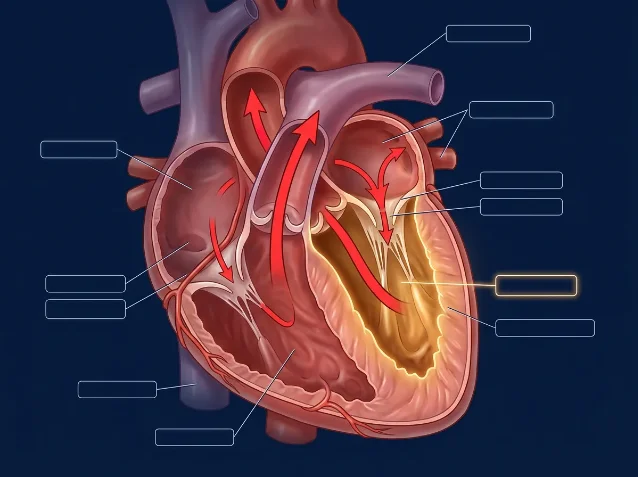
In the HFrEF subgroup — patients with the lowest baseline ejection fractions — the effect was larger:
| Outcome | Effect | 95% CI | p-value |
|---|---|---|---|
| LVEF (all HF patients) | +3.12% | 0.95%–5.30% | <0.01 |
| LVEF (HFrEF subgroup) | +4.25% | 1.99%–6.51% | <0.001 |
| Cardiac output (HFrEF) | +1.24 L/min | 0.24–2.24 | <0.05 |
| Peak systolic annular velocity (HFrEF) | +0.60% | 0.17%–1.02% | <0.01 |
The HFrEF subgroup also showed improvements in cardiac output — the total volume of blood the heart delivers per minute — rising by 1.24 liters per minute, a meaningful increment in a population where cardiac output is often severely reduced. 1
The authors' own summary: "Ketone supplementation significantly improved cardiac function compared with controls, especially in people with HFrEF." 1
Why the heart responds to ketones

The biological rationale is worth briefly unpacking for context. The failing heart is metabolically stressed: it has lost much of its capacity to efficiently oxidize fatty acids, its normal primary fuel. Ketone bodies — specifically beta-hydroxybutyrate — are an alternative fuel the heart oxidizes readily, and prior mechanistic research suggests they may improve cardiac efficiency by reducing the oxygen cost per unit of cardiac work. Exogenous ketone supplements (esters and salts) raise blood ketone levels acutely, providing this alternative fuel without requiring any change to dietary carbohydrate intake.
This is the mechanistic context that makes the LVEF findings credible. It is also the mechanistic context that explains why a ketogenic diet — if it raised ketone levels sufficiently — might in principle benefit heart function. The key phrase is "if." The diet-based studies existed in the systematic review, but the evidence base was too thin for pooling.
The distinction that defines the dietary translation: supplements ≠ diets
This is the point the paper's framing makes easy to miss, and where the dietary translation breaks down.

The meta-analysis result — the 3.12% LVEF improvement — comes entirely from studies using exogenous ketone supplements: manufactured compounds (ketone esters, ketone salts) consumed as a clinical intervention, not from people eating fewer carbohydrates. As the authors state directly: "Meta-analysis could not be performed on LCD or KD studies, due to low study numbers." 1
The practical implications of this distinction:
- "Eating keto" is not the same as supplementing ketones. A ketogenic diet raises blood ketone levels, but the degree, timing, and bioavailability differ substantially from a standardized ketone ester or salt dose used in a clinical trial. The diet also changes dozens of other variables simultaneously (caloric intake, fiber, micronutrients, food matrix).
- There is no pooled evidence that ketogenic or low-carb diets improve heart failure outcomes. The systematic review included LCD and KD studies in its narrative synthesis, but the evidence base was insufficient for meta-analysis. This is not the same as evidence of no effect — it means the question has not been adequately tested yet.
- For patients already managing heart failure, any dietary change — including carbohydrate restriction — carries risks that require clinical supervision. Ketone supplementation as used in these trials is a specialized intervention, not a self-directed dietary strategy.
Caveats in the evidence base
The authors note that certainty of evidence ranged from low to high across outcomes, owing to small cohort sizes and differences in treatment duration between the six pooled RCTs. 1 The meta-analysis does not break down certainty per outcome in the abstract, which limits how confidently any single number can be taken as a definitive estimate.
The study received no industry funding directly. The first author was supported by a Research Training Program scholarship; the corresponding author (Dr. Zaman) holds a Heart Foundation Fellowship and a NSW Health grant. Dr. Zaman disclosed industry relationships with Abbott, Biotronic, Medtronic, Novartis, and Boston Scientific but stated these do not relate to the current manuscript. 1
No independent expert commentary or press coverage of this study appeared within the current collection window. The paper had been available as an early online publication since September 2025 and was first presented at the Cardiac Society of Australia and New Zealand (CSANZ) annual meeting in Brisbane in August 2025 — the July 2026 print issue date represents a calendar event, not a new scientific release. 2
What to do with this today
If you have heart failure and are under cardiology care: this meta-analysis is worth discussing with your cardiologist. Exogenous ketone supplementation is an active area of clinical investigation in heart failure, and the LVEF data — particularly the HFrEF subgroup result — are consistent enough across six RCTs to warrant a serious clinical conversation. Do not start any ketone supplement without specialist guidance; the products vary widely in formulation, dose, and studied populations.
If you are a dietitian working with heart failure patients: the key message to hold is that the evidence currently supports exogenous ketone supplements as a potential adjunct in HFrEF, not ketogenic diets as a dietary strategy. The two are mechanistically related but evidentially distinct. Advising patients to "eat keto for their heart" based on this paper would be an overreach the authors themselves would not endorse.
If you are a health-conscious adult without heart failure: this study has no direct dietary action for you today. The finding is specific to a clinical population (heart failure patients) using a clinical-grade supplement, and the broader dietary ketosis question — whether eating patterns that raise ketones have cardiac benefits in otherwise healthy adults — remains open in the literature.
The finding that exogenous ketones can meaningfully improve cardiac pumping function in a failing heart is genuinely interesting basic science with real clinical implications. The translation to food-based decisions will require the diet-based RCTs that this review identified as a gap.
Cover image: AI-generated illustration.
Add more perspectives or context around this Post.